
Bookkeeping Basics
Why Spreadsheets Stop Working After Year One (And What to Do Instead)

Heidi DeCoux
CEO · Sep 26, 2025
Heidi DeCoux is the founder of Cashflowy, an AI-powered bookkeeping platform, and has worked with thousands of self-employed professionals to simplify finances and improve profitability.
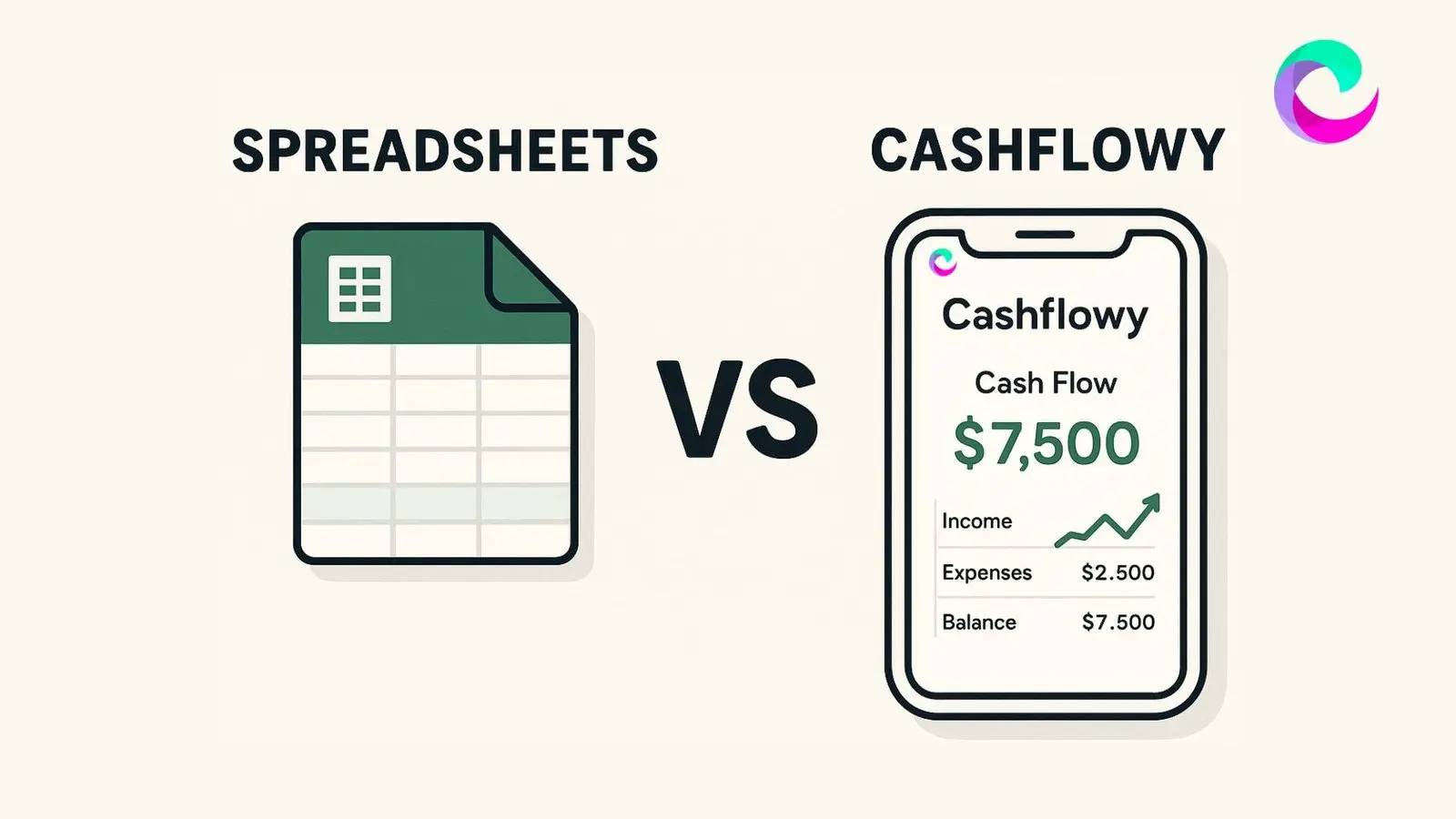
Every freelancer, consultant, and independent business owner starts in the same place. A blank spreadsheet, some color-coded columns, a few carefully crafted formulas, and the satisfaction of having built something that actually works.
For a while, it genuinely does work. You have a handful of clients. Transactions are manageable. You know the spreadsheet well enough to navigate it quickly. It costs nothing, and that matters when you're building something from scratch.
Then the business grows. More clients come in. Income streams multiply. Expenses become harder to track. And slowly, the spreadsheet that once felt like a solid financial system starts to reveal the things it was never actually built to do.
This is not a personal failing. It is a structural one. Spreadsheets are excellent at storing information. They are not built to run a business. And the longer you stay on one past the point where it makes sense, the more it costs you, in time, in money, and in the clarity you need to make good decisions.
Why Spreadsheets Make Perfect Sense at the Start
It is worth acknowledging what spreadsheets do well before explaining where they fall short, because the appeal is real and the reasons people stick with them for so long are understandable.
They are free. When you are bootstrapping and every dollar counts, paying for software feels unnecessary when something free exists that technically does the job.
They are flexible. You can structure a spreadsheet however makes sense for your business model. No template forces you into categories or reporting formats that don't fit.
They require no learning curve. Most people already know how to use a spreadsheet. Setting one up for basic income and expense tracking takes an hour at most.
They feel like control. Building your own financial tracking system gives you a sense that you understand exactly what is in it, because you built every piece of it yourself.
These advantages are real, and they explain why spreadsheets are the default starting point for almost every new business. The problem is not that they are bad tools. The problem is that they are the wrong tools once your business passes a certain point of complexity.
The Specific Ways Spreadsheets Break Down
The failure is rarely dramatic. It is cumulative. A series of small problems that become increasingly significant until the spreadsheet is no longer an asset but an obstacle.
Everything Requires Manual Input
Spreadsheets do not connect to anything. Your bank account, your payment processor, your invoicing system, they all operate completely separately. Every transaction has to be manually entered. Every invoice has to be manually recorded. Every expense has to be manually logged.
When you have ten clients and fifty transactions a month, this is manageable. When you have thirty clients, multiple income streams, and several hundred transactions, it becomes a significant time drain. And every manual entry is an opportunity for error. Research from Sage shows that up to 88% of spreadsheets contain errors, and 35% of companies report discrepancies in their most important spreadsheets. These are not rounding errors. They are the kind of mistakes that distort your understanding of your business.
The Information Is Always Out of Date
The moment you enter data into a spreadsheet, it begins to age. It reflects the state of your business at the moment you last updated it, which may have been yesterday, last week, or last month. There is no live connection to what is actually happening in your accounts.
This means the spreadsheet you are looking at is never a real picture of your current financial position. It is a snapshot of some point in the past. Making decisions based on that snapshot works well enough when your business is simple. It becomes increasingly problematic as complexity grows and speed of decision-making matters more.
It Cannot Alert You to Anything
A spreadsheet is completely passive. It holds data and does nothing with it. It cannot tell you when an invoice is overdue. It cannot flag when a recurring expense has increased. It cannot alert you that your cash position is trending downward and a quarterly tax payment is approaching. It cannot send a payment reminder to a client who is two weeks late.
All of that awareness has to come from you, which means you have to remember to check, remember what you checked last time, and notice the changes yourself. As your business grows, the cognitive load of maintaining that kind of manual vigilance becomes unsustainable.
Version Control Becomes a Problem
Anyone who has managed finances in a spreadsheet for more than a year knows the version confusion problem. Multiple files accumulate. Copies get made for different purposes. Someone shares a version with their accountant and continues editing the original. By the end of the year, there are several files with overlapping but not identical information, and reconstructing the authoritative version requires time and guesswork.
This is not a failure of discipline. It is a failure of the tool. Spreadsheets have no built-in version control, no single source of truth, and no mechanism to prevent conflicting copies from accumulating.
You Cannot See What Is Coming
The most significant limitation of a spreadsheet for business finance is that it only looks backward. It tells you what happened based on what you entered. It cannot model what is likely to happen next month, predict whether you will have enough cash to cover your quarterly tax payment, or show you what your financial position will look like if a particular client pays two weeks late.
Running a business requires forward visibility, not just historical records. The inability to forecast means you are always reacting to your financial situation rather than anticipating and planning for it. That reactive posture is expensive, both in terms of the problems you cannot prevent and the opportunities you cannot confidently pursue.
The Data Lives in Silos
Most business owners who use spreadsheets for any significant period end up with multiple files: one for income, one for expenses, one for invoices, possibly a separate one for tax estimates. These files do not communicate with each other. A change in one does not ripple through the others. Getting a complete picture of your financial position requires opening several files and manually reconciling the information across them.
This fragmentation also creates a security risk. Financial records stored in files on a single device or a shared drive are one accidental deletion, hardware failure, or access revocation away from being lost or inaccessible.
The Real Cost of Staying on Spreadsheets Too Long
The costs that most people associate with staying on a spreadsheet are time-related, and those are real. But the less visible costs are often larger.
Missed deductions. When expenses are not being categorized in real time and automatically, things fall through the cracks. A subscription bought in Q1 gets lost in a miscellaneous row. A client lunch never gets logged. Across a full year, unclaimed deductions represent real money left behind.
Tax surprises. A spreadsheet provides no visibility into your running tax liability. Without a real-time estimate of what you owe, quarterly payments are guesses, and the year-end filing is more stressful than it needs to be.
Poor decisions from bad data. Every significant business decision, whether to take on a new client, invest in a tool, or hire a contractor, should be informed by your actual financial position. If your spreadsheet is two weeks out of date, contains errors, or lacks forward-looking cash flow information, those decisions are made on a shaky foundation.
Accountant cleanup costs. Many business owners hand their accountant a folder of spreadsheets at year-end and pay significantly more than they should because the records require significant cleanup before they can be used. Clean, organized, current financial records reduce accounting fees and result in better advice.
What the Transition Actually Looks Like
Moving from a spreadsheet to purpose-built bookkeeping software is not as complicated as most people expect, and the change in daily experience is immediate.
Instead of manually entering transactions, they import automatically from your bank accounts and credit cards. Instead of categorizing every expense by hand, the software learns your patterns and handles most categorization in the background. Instead of opening a file and piecing together your financial picture, you open a dashboard that shows your current position, outstanding invoices, upcoming expenses, and projected cash flow in a single view.
The monthly financial review that used to take several hours takes 20 minutes. Your records are current when you need them, not after you spend an afternoon updating them. Tax season becomes a process of reviewing and exporting organized records rather than reconstructing a year of activity.
Signs Your Spreadsheet Has Become the Problem
If you are unsure whether you have crossed the threshold, these are the clearest signals:
You estimate your quarterly tax payment rather than calculating it from organized, real-time data.
You regularly discover that invoices went unpaid longer than they should have because you lost track of which ones were outstanding.
Your year-end accounting process takes significantly longer than you think it should because the records need to be pieced together and cleaned up.
You feel uncertain about your actual current cash position without opening multiple files and cross-referencing them.
You have made significant financial decisions without full confidence that your underlying data was current and accurate.
Any one of these is a signal worth taking seriously. Several of them together is a clear indication that the spreadsheet has become a liability rather than a tool.
Frequently Asked Questions
Is there a specific revenue level where spreadsheets stop working? There is no universal threshold, but most freelancers and independent business owners find that spreadsheets become genuinely problematic somewhere between 15 and 30 active clients, or when monthly transactions exceed 100 to 150. The complexity of multiple income streams or product lines accelerates this timeline.
How long does it take to switch from a spreadsheet to bookkeeping software? For most self-employed professionals, the initial setup takes 20 to 30 minutes. You connect your bank accounts, confirm the starting balance, and the software imports recent transaction history. The learning curve is minimal for tools built specifically for small businesses.
Will I lose my historical data from the spreadsheet? Your historical bank data can usually be imported from your bank statements into most bookkeeping software. Your spreadsheet data itself may not transfer directly, but your bank's transaction history typically covers the records you need.
What if I cannot afford the software right now? The time cost of staying on a spreadsheet past the point where it makes sense is almost always higher than the monthly cost of purpose-built software. Missed deductions, tax surprises, and time spent on manual entry and cleanup add up to significantly more than a software subscription in most cases.
Your Business Has Moved Past What a Spreadsheet Can Do
Spreadsheets did exactly what they were supposed to do. They got you started, kept your costs low, and gave you a workable system during the period when simplicity was the right priority.
As your business grows, the right priority shifts from simplicity to clarity. You need to know your actual current financial position, not a two-week-old approximation. You need forward-looking cash flow visibility, not just historical records. You need automation that handles the repetitive work, not a system that demands constant manual attention.
The spreadsheet was a smart starting point. Staying on it past year one is a choice that costs more than most people realize.
If you are ready to move to a system that keeps your finances current, your taxes organized, and your cash flow visible without the manual work, join Cashflowy and see what your finances look like when the tools actually match the business you have built.