Taxes
Real Estate Agent Tax Deductions: The Complete 2026 Checklist

CEO · Jul 20, 2026
Heidi DeCoux is the founder of Cashflowy, an AI-powered bookkeeping platform, and has worked with thousands of self-employed professionals to simplify finances and improve profitability.

Your sales numbers say you had a strong year. But how much of your commission did you actually keep?
Most agents can name the obvious write-offs: mileage, MLS dues, signs and software. The harder part is keeping a complete record of them. A brokerage fee deducted before your commission reaches your account, a showing missing from your mileage log or a receipt buried in your inbox can all turn into missed deductions at tax time.
We put together this guide to cover the main real estate agent tax deductions available to self-employed agents in 2026, including the IRS mileage rate change that took effect on July 1.
We also explain how to track expenses throughout the year so the deductions you qualify for make it onto your return.
This is educational information, not tax advice. Talk to your tax professional about your specific business and personal tax situation.
What's new in the 2026 tax year
Three federal tax changes are especially relevant to self-employed real estate agents in 2026:
- The standard mileage rate changed midyear. The rate is 72.5 cents per business mile from January 1 through June 30 and 76 cents per business mile from July 1 through December 31.
- The QBI deduction is now permanent. Eligible agents may continue to deduct up to 20% of qualified business income. Beginning in 2026, those with at least $1,000 in total qualified business income from an active trade or business may also qualify for a minimum $400 deduction.
- The Form 1099 reporting threshold increased. The threshold for qualifying Form 1099-NEC payments and certain Form 1099-MISC payments rose from $600 to $2,000 for 2026. This affects whether the payer must issue a form. Contractors must still report all taxable income, even if they don’t receive one.
What counts as a legitimate business expense
The IRS allows you to deduct expenses that are ordinary and necessary to run your real estate business. "Ordinary" means the expense is normal for an agent to have. "Necessary" means it's helpful and appropriate for the work, not that it's unavoidable.
For example, yard signs are ordinary and necessary. A suit you also wear to a wedding is not, no matter how many client meetings you wear it to.
Most licensed real estate agents are treated as self-employed for federal tax purposes if their pay is based primarily on sales or other output and their written contract says they are not employees. In that case, the brokerage generally doesn't withhold federal income tax or Social Security and Medicare taxes from commissions.
Most self-employed agents operate as sole proprietors and report their business income and deductible expenses on Schedule C. If your net earnings from self-employment are $400 or more, you generally calculate self-employment tax on Schedule SE. You may also owe federal and state income tax.
That means you are responsible for tracking your business expenses and setting aside enough to cover the taxes you owe.
Start with your commission statement, not the deposit
The amount that reaches your account doesn't reflect how the payment was calculated. Your commission statement may include your share of the deal, followed by transaction fees, referral payments or other charges deducted before you got your balance.
Say the brokerage receives a $12,000 commission. Under a 70/30 split, $8,400 is allocated to you and $3,600 remains with the agency. If a $400 transaction fee and a $1,200 referral payment are then taken from your share, you receive $6,800.
You shouldn't automatically record $12,000 as your income and $5,200 as your expenses.
The brokerage’s $3,600 share may never have been your income. Start with the commission allocated to you on the deal statement, record any fees paid from your share separately and reconcile the annual total with Form 1099-NEC. If an expense has already been excluded from the income you report, don't deduct it again.
Recording only the $6,800 deposit may produce the same net profit, but it hides how much you earned and what the deal cost you. Separating the commission from the fees gives you a clearer record and makes it easier to check your year-end tax forms.
Bank deposits also miss expenses paid when no deal closes. Desk fees, MLS dues and technology subscriptions can continue during a slow month. If you review only commission deposits, those costs are easy to overlook.
The four costly mistakes of self-employment taxes among agents
- Recording deposits instead of gross commissions.
- Running personal and business expenses through one account.
- Reconstructing a mileage log at tax time.
- Sorting a year of receipts once a year.
The real estate agent tax deduction checklist
Common business purchases that self-employed real estate agents may be able to deduct include:
- Brokerage desk fees and transaction fees paid by the agent and not already netted from reported income
- MLS fees and the deductible portion of NAR and state association dues
- E&O and other qualifying business insurance premiums
- Business vehicle expenses calculated using either the standard mileage rate or the actual expense method
- Open house signs, riders and directional signage
- Agent-paid staging costs and furniture rentals
- Listing photography, video and 3D tours
- Lead generation and paid advertising
- CRM and transaction management software
- Continuing education that maintains or improves existing professional skills and business-related coaching
- Qualifying home office expenses
Want the full version? Download the 2026 real estate agent tax deduction checklist, organized by Schedule C category so that you can hand it straight to your tax professional.
[Get the checklist]
Vehicle and mileage expenses
Vehicle costs are one of the largest deductions for most real estate agents. You can use either the IRS standard mileage rate or the actual expense method.
In 2026, the business mileage rate is 72.5 cents per mile from January 1 through June 30 and 76 cents from July 1 through December 31. Keep separate mileage totals for each period. Business parking and tolls can be deducted in addition, but regular commuting is personal.
The actual expense method uses the business share of costs such as fuel, insurance, repairs, registration, lease payments and depreciation. The rules for switching methods depend on whether you own or lease the vehicle. Whichever method you use, keep a current mileage log with the date, destination, business purpose and miles.
Business parking fees and tolls can be deducted, too, but parking at your regular place of work is considered part of your commute and isn’t deductible.
Brokerage costs, splits and referral fees
You can usually deduct desk fees, transaction fees and brokerage technology fees. Referral fees and payments to team members, co-listing agents or transaction coordinators may also qualify.
A brokerage split needs closer attention. If the brokerage’s share was never income attributable to you, it won't be your deductible expense. Before recording income or fees, reconcile your commission statements, deposits and Form 1099-NEC.
Qualifying payments to an agent or contractor may also trigger a Form 1099-NEC. The federal reporting threshold increased to $2,000 for 2026, although exceptions and state requirements may apply.
Licensing, dues and professional membership fees
You can also usually deduct license renewals, MLS access, lockbox services and professional association dues. If an association uses part of your dues for lobbying, that portion isn’t deductible. Check your annual dues statement to see how much you can claim.
Continuing education that maintains or improves your real estate skills may also qualify. Pre-licensing courses and education that prepares you for a new trade generally do not.
Marketing costs and lead generation
Advertising, signage, websites, lead generation, listing media, staging and furniture rentals may qualify as deductible business expenses if you pay for them. If a client or brokerage reimburses you, the tax treatment may be different. Keep the invoice, proof of payment and the property or campaign connected to each expense for reference.
Home office deduction
You could also include home office expenses if you have a specific area dedicated to your business. It must be your principal place of business or the place where you handle administrative work.
The simplified method allows $5 per square foot for up to 300 square feet. The actual expense method uses the business share of eligible household costs. Having a brokerage desk doesn’t automatically disqualify you, but you may need to prove where you actually perform your administrative work.
The business portion of phone and internet costs may still be deductible even if you don’t claim a home office.
Office supplies, equipment and rent office space
Routine office supplies and software subscriptions, including your CRM, transaction management platform and real estate accounting software, are generally deductible. Larger purchases may need to be depreciated. It's best to give your tax professional the receipts for larger purchases rather than assuming they can be written off.
You can also factor in rent for an outside office, coworking space or office furniture you bought.
Business meals, travel and client gifts
You can usually deduct half of the cost of qualifying business meals. Keep the receipt along with the attendee and business purpose. Entertainment expenses like sporting events or concert tickets don't count.
If you travel overnight for a conference, training or other business purpose, you may be able to factor in costs such as flights, hotels and local transportation. Regarding client or referral partner gifts, the deductible amount is limited to $25 per person each year.
Professional services, insurance and health coverage
Fees paid to a bookkeeper, tax professional or attorney for work directly related to your business are deductible. If a virtual assistant or transaction coordinator works as an independent contractor, their fees may be deducted as contract labor. Costs related to forming a new business can be treated differently, so keep those expenses separate.
Premiums for E&O, general liability, cyber and business property insurance can also be deductible.
Health insurance follows different rules. If you’re eligible, you may be able to deduct premiums for yourself and your family from your taxable income, but you don’t record them as a business expense on Schedule C.
The deductions that are not expenses
Some valuable deductions don’t appear in your expense records.
You can deduct the employer-equivalent portion of your self-employment tax when calculating adjusted gross income. That deduction can reduce income tax, but it doesn't lower the self-employment tax itself.
The qualified business income deduction may allow eligible agents to deduct up to 20% of qualified business income (subject to income limits and other rules). Since 2026, an eligible active business with at least $1,000 of qualified business income may qualify for a minimum $400 deduction.
SEP IRA and solo 401(k) contributions may also reduce taxable income, subject to contribution limits and deadlines. These deductions are handled outside Schedule C, so review them separately with your tax professional.
What you cannot deduct
Not deductible:
- commuting between home and your office,
- entertainment expenses,
- everyday clothing and grooming,
- pre-licensing education,
- political contributions,
- club dues,
- fines and penalties,
- personal expenses.
Home improvements to your personal residence are personal, even if you occasionally take calls there.
The rule of thumb: if the expense doesn't relate to earning income in your real estate business, assume it's not deductible.
Your pipeline is current. Your books should be too.
Every closing creates a trail of commission statements, brokerage charges and business expenses. Leave that trail untouched until tax season, and you're left rebuilding the year from statements, receipts and memory.
A deduction can only reach your return if your records support it. But just recording the expense doesn't reserve cash for taxes. You need a clear view of what the business earned throughout the year, what it spent, what has been set aside for taxes and what is safe to pay yourself.
Cashflowy gives solo agents those numbers without adding another spreadsheet or complicated bookkeeping project. Connect your financial accounts through Plaid in under 2 minutes and get immediately categorized and reconciled transactions. Expenses paid from those accounts, such as MLS dues, advertising, software and insurance, stay organized from the moment they happen.
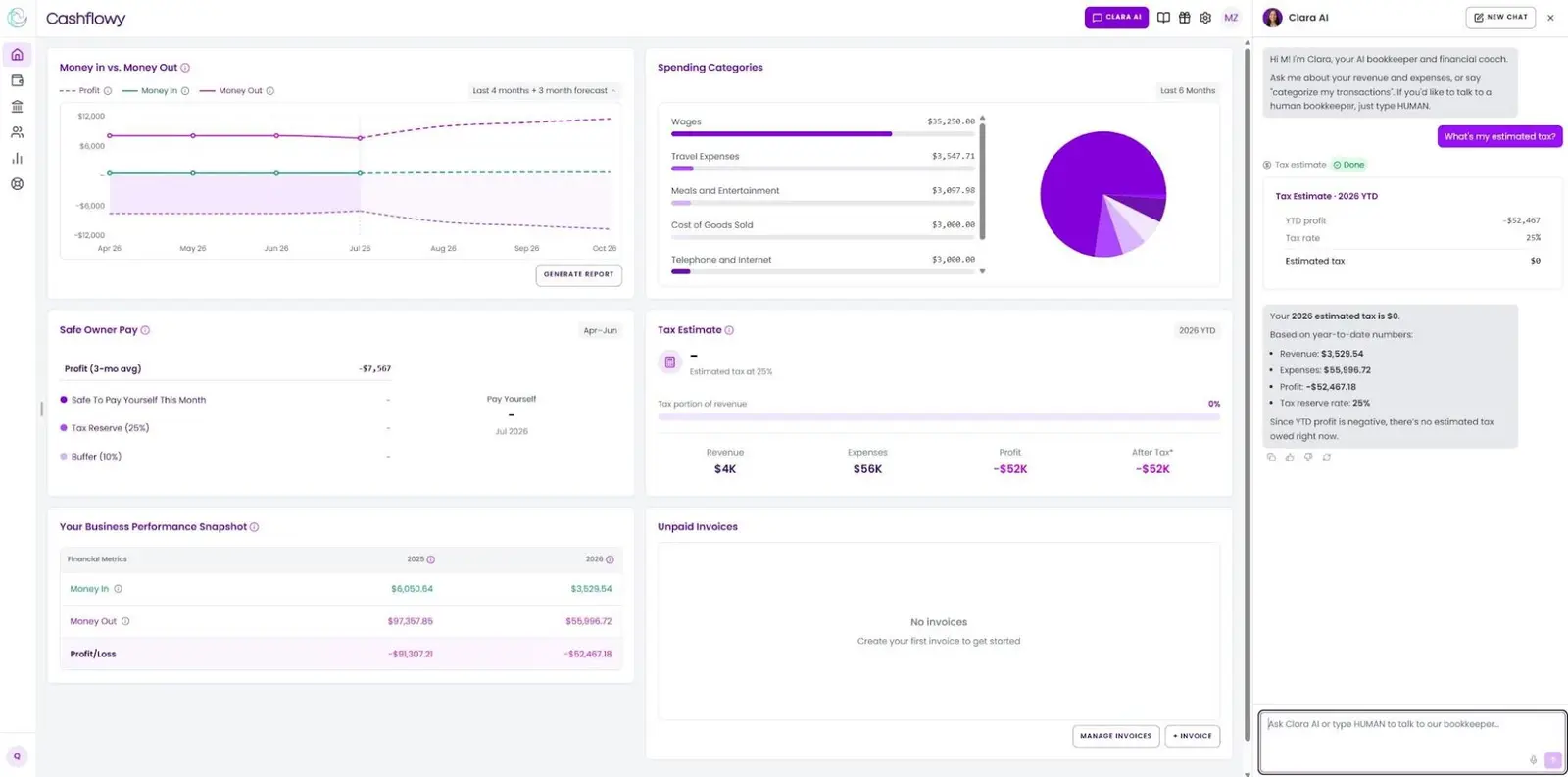
Once your accounts are connected, the dashboard shows income, expenses and cash flow clearly labeled and always up to date. You can finally judge the month by what you earned instead of judging the business by the commission deposits.
For agents with uneven commission income, the Safe Owner Pay may be the most useful feature. It analyzes your recent revenue, expenses, tax set-aside and upcoming bills to give you a safe owner’s pay amount based on the percentages you're comfortable with. The tax tab tracks your estimated monthly set-aside, so you can see whether you're building a solid reserve before tax season.
When you want to dig into the numbers, Cashflowy answers questions using your actual account data. You can ask what you spent on advertising, where expenses increased or how much you can safely pay yourself if you don't get another closing for two weeks. If you need expert help, human bookkeepers are available via unlimited live chats and scheduled private calls at no extra charge.
Keep in mind Cashflowy doesn't file your taxes or tell you what you legally owe. It keeps your books current and your estimated tax set-aside visible, giving your tax professional cleaner records to work with.
Setup takes about 6 minutes. Start your free trial to see how it handles your real numbers.
Make next tax season a handoff, not a cleanup.
Knowing which expenses are deductible is only useful if you have the records to support them. Use the checklist to see what to track, then let Cashflowy keep your everyday income and expenses organized as they happen.
When tax season arrives, you can give your tax professional current books and clear reports instead of spending hours reconstructing the year.
Start your free Cashflowy trial. Get set up in about 6 minutes. Cancel anytime, with a 30-day money-back guarantee.
Frequently Asked Questions
What can a real estate agent write off on taxes?
What is the IRS standard mileage rate for 2026?
Can I claim a home office if I have a desk at my brokerage?
Do real estate agents pay quarterly estimated taxes?
Is clothing or grooming tax deductible for real estate agents?
Keep reading

How to Set Up a Business Tax Reserve Account (Step by Step)
A dedicated Tax Reserve account moves tax money out of reach the moment it lands, so tax time is a quick payment, not a scramble. Here is how to set one up.

Quarterly Estimated Taxes for Self-Employed: The Exact Calculation