
Profit First Method Explained: The Complete Guide to Paying Yourself First
Learn how the Profit First method works, set up your 5 bank accounts, find your ideal allocation percentages, and automate the system. Step-by-step guide for small businesses.

Heidi DeCoux is the founder of Cashflowy, an AI-powered bookkeeping platform, and has worked with thousands of self-employed professionals to simplify finances and improve profitability.
Your business is generating revenue. Your clients are paying. Your inbox is full of invoices. And yet, when you check your bank account at the end of the month, you wonder where all the money went.
If that sounds familiar, you are not alone. According to a U.S. Bank study, 82% of small businesses fail because of cash flow problems. Not because they lack customers, and not because their product is bad. They simply run out of money because there is no system in place to protect profit before expenses consume everything.
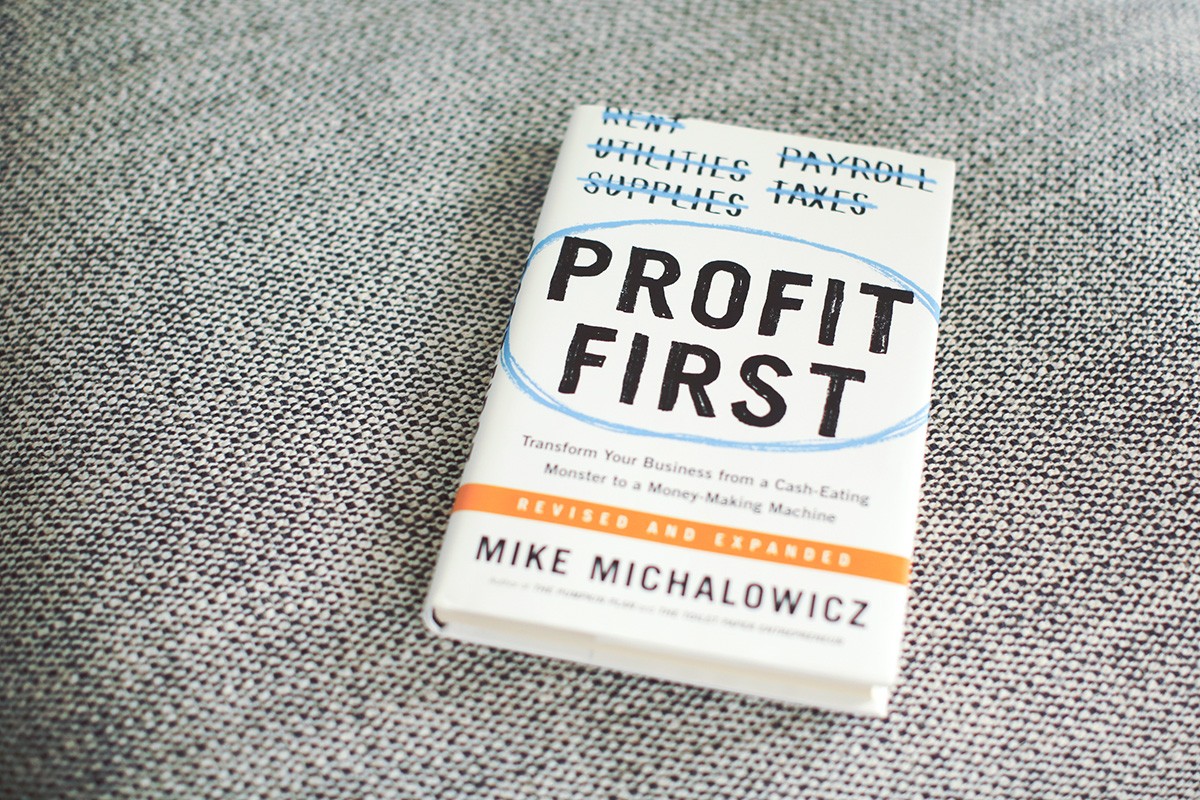
The Profit First method, created by Mike Michalowicz, flips the traditional accounting formula on its head. Instead of Revenue – Expenses = Profit, it works like this: Revenue – Profit = Expenses.
The difference is not just mathematical. It is behavioral. By taking profit first, you force your business to operate on what remains, which naturally drives smarter spending, leaner operations, and actual money in your pocket.
In this guide, you will learn exactly how the Profit First system works, how to set up your bank accounts, which allocation percentages to use based on your revenue, and how tools like Cashflowy can automate the entire process so you spend less time managing spreadsheets and more time growing your business.
What Is the Profit First Method?
Profit First is a cash management system designed for small business owners, freelancers, and entrepreneurs. The core idea is simple: every time revenue comes into your business, you allocate a percentage to profit before paying any expenses.
Think of it like the envelope budgeting system your grandparents may have used. You divide your money into separate "envelopes" (bank accounts) and only spend what is in each envelope. When the operating expenses envelope is empty, you stop spending. You do not dip into profit.
The method is built on four principles:
Use small plates. Just like eating from a smaller plate tricks you into eating less, having less money available for expenses forces you to spend less.
Serve sequentially. Profit, taxes, and your pay come first. Expenses get what remains.
Remove temptation. Your profit and tax accounts should be at a separate bank so you are not tempted to dip in.
Enforce a rhythm. Allocate funds on the 10th and 25th of every month. Consistency turns this into a habit, not a chore.
Profit First vs. Traditional Accounting: What Actually Changes
Most business owners operate under the traditional formula without questioning it. Revenue comes in, expenses go out, and whatever is left (if anything) is profit. The table below breaks down the key differences between these two approaches.
Traditional Accounting | Profit First Method | |
Core Formula | Revenue – Expenses = Profit | Revenue – Profit = Expenses |
When You Get Paid | After all expenses are covered (if anything is left) | Every allocation cycle, before expenses |
Spending Behavior | Expenses expand to consume all available revenue (Parkinson’s Law) | Expenses are constrained by what remains after allocations |
Tax Preparation | Scramble at year-end or quarterly deadlines | Tax money set aside automatically every cycle |
Financial Clarity | Requires reviewing P&L statements and reports | Instant clarity by checking bank account balances |
Emotional Impact | Stress, uncertainty, “where did the money go?” | Confidence, control, quarterly profit celebrations |
Best For | Large enterprises with CFO and finance teams | Small businesses, freelancers, solopreneurs, startups |
Key takeaway: Traditional accounting tells you what happened. Profit First tells you what to do about it. One is a rearview mirror; the other is a GPS.
The 5 Profit First Bank Accounts (And What Each One Does)
The foundation of the Profit First system is multiple bank accounts. This is not complicated, it is intentional. Each account has one job, and separating your money physically prevents the mental gymnastics of trying to figure out how much you can "really" spend.
Account | Purpose | Pro Tip |
Income | All revenue lands here first. This is a temporary holding account, not a spending account. | Never pay expenses directly from this account. |
Profit | Your reward for running the business. Accumulates quarterly for profit distributions. | Open this at a different bank to reduce the temptation to transfer it back. |
Owner’s Pay | Your salary. This is how you consistently pay yourself, not from whatever is left over. | Set a regular pay schedule (biweekly or monthly) so it feels like a real paycheck. |
Tax | Holds money for income taxes, quarterly estimated payments, and year-end obligations. | Use a high-yield savings account to earn interest while the money sits. |
Operating Expenses | Covers rent, software, contractors, marketing, and all business costs. This is the only account you spend from. | If this account is running low, cut expenses. Do not borrow from other accounts. |
Pro tip for freelancers: If five accounts feels like too much, start with three: Income, Profit + Tax (combined), and Operating Expenses. You can split them later as your revenue grows.
Profit First Allocation Percentages by Revenue
One of the most common questions is: how much should I allocate to each account? Mike Michalowicz provides Target Allocation Percentages (TAPs) based on your real revenue (total revenue minus materials and subcontractors). These are not rigid rules but rather targets to work toward.
The table below shows recommended allocation percentages based on where your business stands today.
Real Revenue | Profit | Owner’s Pay | Tax | OpEx | Total |
$0 – $250K | 5% | 50% | 15% | 30% | 100% |
$250K – $500K | 10% | 35% | 15% | 40% | 100% |
$500K – $1M | 15% | 20% | 15% | 50% | 100% |
$1M – $5M | 10–20% | 10% | 15% | 55–65% | 100% |
$5M+ | 20%+ | 5–10% | 15% | 55–60% | 100% |
Important: Do not try to hit these targets on day one. If your current profit allocation is 0%, start with 1% and increase it by 1–2% every quarter. The system works because it is gradual. Trying to jump straight to 15% profit will create cash flow problems rather than solve them.
Also note that “real revenue” means total income minus direct costs of materials and subcontractors. If you are a service-based business with no material costs, your real revenue equals your total revenue. If you sell physical products, subtract your cost of goods first.
How to Implement Profit First: A Step-by-Step Walkthrough
Getting started with Profit First does not require an accounting degree. Here is the process, broken into clear steps.
Step 1: Know Your Numbers
Before opening a single bank account, you need a clear snapshot of where your money goes today. Pull the last three months of bank statements and calculate your current allocation percentages. What percentage of revenue went to your pay? To taxes? To operating costs? To profit? If the profit number is 0% or negative, that is your starting point, and that is fine.
Step 2: Open Your Accounts
Open the five core accounts outlined above. For your Profit and Tax accounts, Michalowicz recommends opening them at a separate bank (not the one you use daily). This creates a physical barrier between you and the money, making it harder to raid those accounts when operating expenses feel tight.
Step 3: Set Your Starting Percentages
Use the allocation table above as a reference, but start where you actually are, not where you want to be. If you currently allocate 0% to profit, set your initial allocation at 1%. The goal is to build the habit first and optimize the numbers later.
Step 4: Run Your First Allocation
On your next allocation day (the 10th or 25th, whichever comes first), transfer the accumulated income in your Income account to each account based on your percentages. This first transfer will feel small. That is normal. The power of Profit First is in the repetition.
Step 5: Repeat Twice Per Month
Every 10th and 25th, repeat the allocation process. Over time, this 10-minute ritual becomes the financial heartbeat of your business. You will start making decisions differently because you can see exactly how much money is available for each purpose.
Step 6: Take Your Quarterly Profit Distribution
Every quarter, take 50% of whatever has accumulated in your Profit account as a distribution. This is your reward for running a profitable business. The other 50% stays as a cash reserve. This is not optional. The distribution is what makes the system sustainable because it reinforces the behavior emotionally.
5 Common Profit First Mistakes (And How to Avoid Them)
Even with a clear system, business owners make predictable mistakes. Here are the five most common ones based on community discussions and practitioner feedback.
Starting with percentages that are too high. If you jump from 0% to 15% profit overnight, you will create a cash crunch. Start with 1–2% and increase gradually every quarter.
Skipping the allocation rhythm. The 10th and 25th schedule is not arbitrary. It creates discipline. If you only allocate “when you remember,” the system breaks down within a month.
Using one bank for everything. The point of separate accounts is to create behavioral friction. If all your accounts are at the same bank with easy transfers, the temptation to “borrow” from Profit is too high.
Never taking the quarterly distribution. Some owners let the profit account grow but never actually take the money. The quarterly distribution is the reward that keeps you motivated. Take it.
Managing it all manually with spreadsheets. Spreadsheets work in theory, but in practice they require constant updating, are prone to errors, and add another task to an already overloaded week. Automating the tracking and allocation process removes this friction entirely.
How to Automate Profit First (Without the Spreadsheet Headaches)
Here is the reality: 67% of business owners who practice Profit First still track their allocations manually. They use spreadsheets, notebook calculations, or mental math. And many of them eventually fall off the system, not because the method does not work, but because the manual effort becomes unsustainable.
This is where automation changes the game. The right software does not just track your numbers; it runs the Profit First rhythm for you.
Task | Manual (Spreadsheets) | Automated (Software) |
Categorizing transactions | Review each transaction manually, copy-paste into categories | AI auto-categorizes as transactions come in |
Calculating allocations | Run formulas every 10th and 25th, check for errors | Percentages applied automatically in real time |
Tracking tax obligations | Estimate quarterly taxes manually, hope for accuracy | Real-time tax tracking with quarterly estimates built in |
Knowing your safe take-home | Guess based on last month’s numbers | Calculated in real time based on current data |
Time per month | 4–8 hours | Under 30 minutes |
Error risk | High (formula errors, missed transactions) | Low (automated data sync) |
Cashflowy was built specifically for business owners who want to run a profitable operation without drowning in financial admin. It pulls transactions automatically, categorizes them with AI, calculates your safe take-home pay in real time, and tracks your tax obligations so there are no surprises at the end of the quarter. At $39 per month, it replaces the spreadsheet, the guesswork, and the 4+ hours of manual work that cause most people to abandon Profit First.
The point is not to replace your financial awareness. It is to remove the friction that prevents you from actually following through on the system.
Profit First in Action: A Quick Example
To see how Profit First actually plays out, let us walk through a real scenario. Imagine you are a freelance graphic designer earning $8,000 per month in revenue. Under the traditional model, you would pay all your expenses first (software subscriptions, a coworking space, a contractor, taxes) and whatever is left becomes your profit. Most months, that number is close to zero.
Now apply Profit First with starting allocations based on the $0–$250K revenue bracket:
Income received: $8,000
Profit (5%): $400 → transferred to Profit account
Owner’s Pay (50%): $4,000 → transferred to Owner’s Pay account
Tax (15%): $1,200 → transferred to Tax account
Operating Expenses (30%): $2,400 → transferred to OpEx account
Now you have $4,000 as your paycheck (consistent, reliable), $1,200 set aside for taxes (no surprises), $400 building toward your quarterly profit distribution, and $2,400 to run your business. If $2,400 is not enough to cover your current expenses, that is the signal to cut costs, not to raid your Profit account.
After one quarter, your Profit account holds $1,200. You take 50% ($600) as your quarterly reward and keep $600 as a cash reserve. It is not life-changing money yet, but it is real profit in your pocket, and it will grow every quarter as you optimize your expenses and increase your allocation percentages.
Who Should (And Should Not) Use Profit First?
Profit First works best for:
Small business owners generating $50K–$5M in annual revenue who want better control over cash flow.
Freelancers and solopreneurs tired of the feast-or-famine income cycle and invoice anxiety.
Startup founders who want to build a sustainable, profitable business from day one rather than chasing growth at all costs.
Service-based businesses (coaches, consultants, agencies) with variable monthly income.
Profit First may not be the best fit for:
Large enterprises with dedicated finance teams and complex multi-entity structures.
Businesses in a pre-revenue phase with zero income to allocate.
Anyone looking for a get-rich-quick hack. Profit First is a system, and systems require consistency.
Frequently Asked Questions About Profit First
How much money do I need to start Profit First?
You do not need a minimum amount. If your business generates any revenue at all, you can start Profit First. Even allocating 1% of $1,000 in monthly revenue ($10 to your Profit account) is enough to build the habit. The amount matters less than the consistency.
Do I really need five separate bank accounts?
Five accounts is the recommended structure, but it is not mandatory from day one. If five feels overwhelming, start with three: Income, Profit + Tax (combined), and Operating Expenses. As you get comfortable with the rhythm, split them into the full five. Many online banks offer free sub-accounts that make this easy.
What if I cannot afford to pay myself AND set aside profit?
This is the most common concern, and it usually signals that your business expenses are too high relative to your revenue. Start with a tiny profit allocation (even 1%) and keep your Owner’s Pay where it currently is. Over time, as the system forces you to trim expenses, both numbers will improve. Profit First is not about doing everything at once; it is about doing a little more every quarter.
How often should I adjust my allocation percentages?
Review and adjust once per quarter. During your quarterly profit distribution, assess whether you can increase your Profit percentage by 1–2%. The goal is gradual improvement, not overnight transformation. Most businesses reach their Target Allocation Percentages (TAPs) within 12–18 months.
Can Profit First work with irregular income?
Yes, and this is one of its greatest strengths. Because you allocate based on percentages of whatever comes in, the system adapts naturally to high-revenue and low-revenue months. Freelancers and seasonal businesses often find Profit First works better for them than traditional budgeting precisely because it does not rely on a fixed monthly income.
What is the difference between Profit First and zero-based budgeting?
Both systems assign a job to every dollar, but the key difference is priority. Zero-based budgeting allocates funds to categories without a mandated order. Profit First specifically requires that profit and owner’s pay are funded before operating expenses, which creates a built-in constraint that drives smarter spending.
Start Small, Stay Consistent, and Let the System Work
The Profit First method is not complicated. It is five bank accounts, a set of percentages, and a twice-monthly rhythm. What makes it powerful is that it works with human behavior instead of against it. By taking profit first, you remove the willpower problem that sinks most financial plans.
The biggest risk is not starting wrong. It is not starting at all. Open the accounts, set your first allocation at 1%, and run your first transfer on the next 10th or 25th. Within 90 days, you will have more financial clarity than most business owners achieve in years.
And if you want to skip the spreadsheet phase entirely, Cashflowy handles the tracking, categorization, and tax calculations automatically, so you can focus on what you do best: running your business.